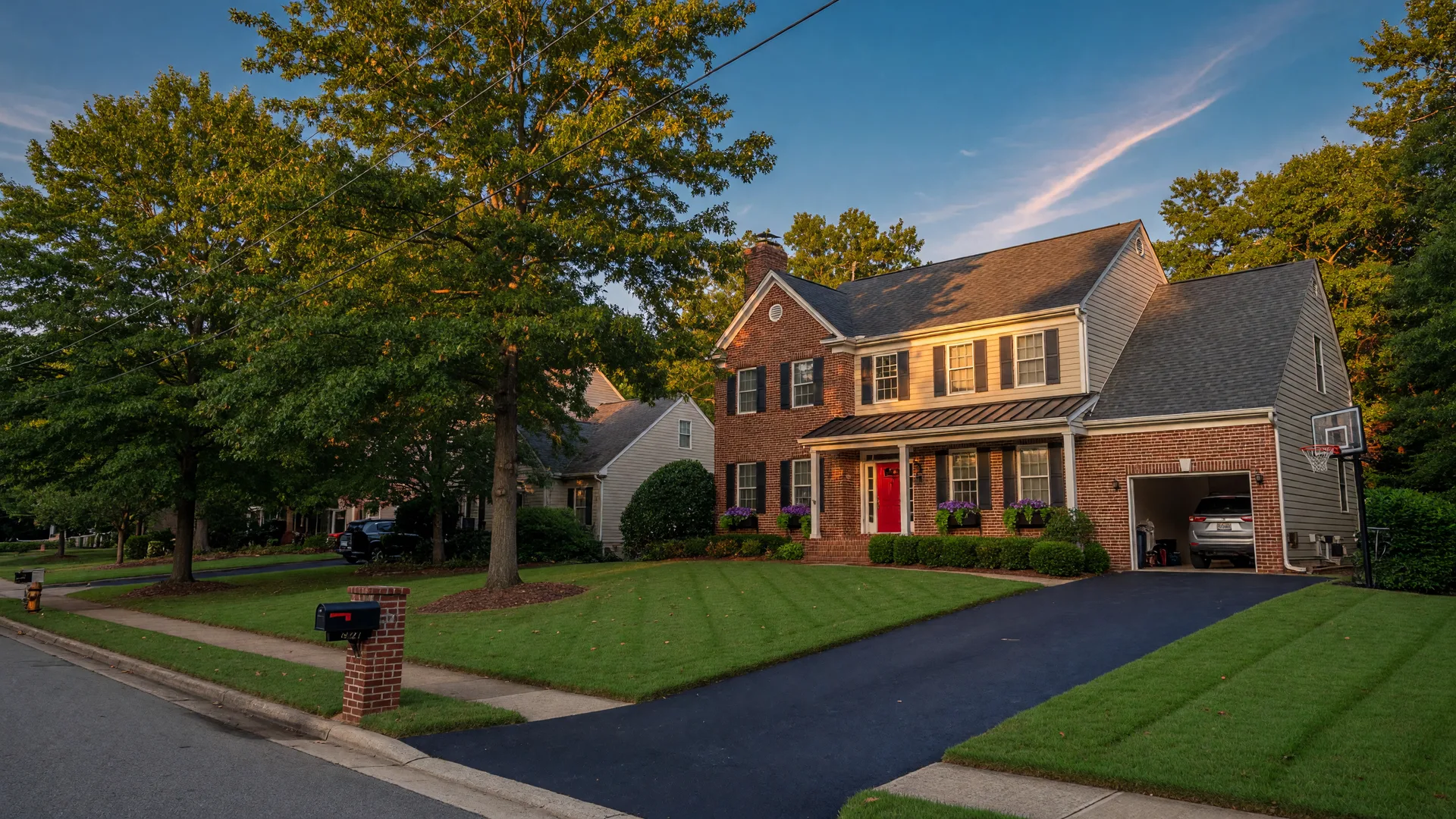
Most relocating buyers are more surprised by the insurance line in their monthly housing math than by the price of the home itself. The honest 2026 answer: expect to pay roughly $2,400 to $2,900 a year for homeowners insurance on a typical Raleigh home, after North Carolina's two-step 15% base rate increase that landed between mid-2025 and mid-2026. That sits above the national average of about $2,543 to $2,575, but below the state's coastal-heavy average near $3,025 to $3,124, because the beach counties carry the hurricane risk, not the Triangle.
This is the number, plus the fine print about wind, hail, and flood coverage that most out-of-state buyers never see until closing. I have run this math for relocating families for two decades, and the insurance quote is the gap between a budget that works and a budget that hurts. Here is what you should actually expect, and where the honest numbers come from.
"To give you total clarity, unfiltered local data, and zero risk, backed by a lifetime guarantee that puts your peace of mind first."
The short answer
Homeowners insurance on a typical Raleigh home runs roughly $2,400 to $2,900 a year in 2026, or about $200 to $240 a month once it is escrowed into your mortgage payment. North Carolina base rates rose 7.5% in June 2025 and another 7.5% in June 2026, and wind, hail, and flood coverage have their own rules you need to know before you buy. It is a real cost, but a manageable and predictable one when you plan for it.
What Homeowners Insurance Actually Costs in Raleigh in 2026
Published 2026 quotes for a typical Raleigh home cluster in a fairly tight band. Different quoting services use different dwelling values and coverage limits, which is exactly why the numbers vary a little. The figures you will see: about $2,420 from Hippo, roughly $2,502 from MoneyGeek, a projected $2,707 from AllAboutInsurance, and $2,850 from Insure.com for a modeled policy on a $300,000 dwelling with $100,000 in liability and a $1,000 deductible.
The honest framing is not to fixate on any single quote. Your exact address, rebuild cost, roof age, and chosen limits move the number, sometimes by several hundred dollars. Plan your budget around the $2,400 to $2,900 band and then shop to land on the right end of it. And remember the Triangle sits on the low end of North Carolina: the statewide average near $3,025 to $3,124 is pulled up by the coastal counties, so an inland Wake County policy is typically cheaper than a comparable one in Wilmington or the Outer Banks.
Why Rates Just Went Up About 15% in North Carolina
If you are moving here from a state that has not seen a big jump, the increase is worth understanding so it does not feel random. In early 2025, North Carolina Insurance Commissioner Mike Causey reached a settlement with the NC Rate Bureau that raised average statewide base rates 7.5% on June 1, 2025, and a further 7.5% on June 1, 2026, for roughly a 15% cumulative increase by mid-2026. The insurers had originally asked for 42.2%, so the negotiated number was a real compromise, but it still landed on every policy in the state.
The drivers behind it are structural, not a one-off. North Carolina carriers have paid out more than $3.2 billion in hurricane and severe-weather claims since 2018. Global reinsurance costs, which insurers buy to back their own risk, jumped roughly 25% to 40%. Construction and labor inflation have raised what it costs to rebuild a home, and rising home values push dwelling coverage limits higher. Each of those factors independently pushes your premium up, and together they explain most of the increase.
Wind and Hail Deductibles: The Fine Print That Costs People
Here is the part most buyers never hear until a claim. Raleigh is inland, in Wake County, so wind and hail coverage is normally included in a standard homeowners policy, unlike coastal North Carolina where some areas need separate wind-only coverage. But North Carolina allows wind and hail deductibles to be set as a percentage of your dwelling coverage rather than a flat dollar amount, commonly 1%, 2%, or 5%.
The math matters. A 1% deductible on a $400,000 dwelling means you are on the hook for $4,000 out of pocket on a wind or hail claim, and a 2% deductible doubles that to $8,000. There is also a named-storm rule: the percentage deductible applies the moment a formal advisory, watch, or warning is issued for any part of North Carolina and it stays in effect until 24 hours after the storm ends. During that window you cannot fall back to a flat deductible. Ask the agent exactly what deductible your quoted policy carries, and understand it before you sign, not after a storm.
Flood Insurance in Inland Raleigh: Do You Actually Need It?
The rule is simple and it trips up a lot of relocators: a standard homeowners policy never covers rising water, so flood damage is excluded unless you buy separate flood insurance. Whether it is required depends on where your home sits. Homes in FEMA Special Flood Hazard Areas, Zones A and AE, generally must carry flood insurance if they have a federally backed mortgage. Most Raleigh homes, however, fall in Zone X, which is moderate-to-low risk, where flood insurance is recommended but not lender-required.
The honest caveat is that Raleigh has more than 23 square miles of mapped floodplain, concentrated along the Neuse River, Crabtree Creek, and Walnut Creek, and heavy storms flood areas beyond the official maps every few years. For most Zone X properties, flood coverage through the NFIP's preferred-risk program or a private carrier is a fraction of coastal flood premiums, and for a few hundred dollars a year it can save you from a devastating loss. I generally tell buyers to run a flood-zone check on the exact address before writing an offer, and to add flood coverage unless they have a strong reason not to.
How Insurance Fits Into Your Monthly Payment
Your lender will almost always escrow homeowners insurance along with property taxes, so you pay a monthly slice instead of one annual lump sum. On a median-priced Raleigh home around $445,000, insurance at roughly $2,400 to $2,900 a year adds about $200 to $240 a month. That is a real line item, but it is not the headline of your housing budget.
Property taxes on that same home run roughly $340 a month at current Wake County and Raleigh combined rates, as I break down in my Raleigh property tax guide. Put the two together with principal and interest and the typical total monthly housing cost on a median-priced home comes to about $2,732, the number I use in my full cost-of-living breakdown. When I compare that to renting, the full picture in my rent versus buy math only makes sense if insurance and taxes are both in the budget.
Six Ways to Keep the Premium Honest
You cannot stop the statewide rate increases, but you can make sure you are not paying more than you should for the coverage you need. These are the levers that move a Raleigh quote the most:
- Shop every one to two years. North Carolina rates are not standardized across carriers, so a company that was cheapest for you two years ago may not be now.
- Bundle home and auto. Multi-policy discounts are the easiest way to knock several hundred dollars off a combined bill.
- Raise your deductible. Moving from $1,000 to $2,500 or $5,000 is the single biggest premium saver, if you have the savings to cover it.
- Check your credit-based insurance score. It is a rating factor in North Carolina, so cleaning up errors before you quote can help.
- Ask about roof and new-construction credits. A newer or impact-resistant roof, updated electrical, and modern plumbing all qualify for discounts.
- Do not underinsure the dwelling. Rebuild cost is not the same as market value. Carry enough coverage plus an extended replacement endorsement so a total loss actually rebuilds your house.
A 20-Year Local's Honest Take
Homeowners insurance is the recurring cost that out-of-state buyers most often underestimate, because buyers from low-risk states have never watched a premium climb. When I build a monthly budget with a relocating client, insurance goes in alongside taxes and any HOA fee, because the number that decides whether a home is affordable is the total monthly cost, not the sale price or the rate.
The good news is that the Triangle sits in a relatively mild insurance corner of North Carolina, and the costs are predictable if you plan for them. Get the exact quote for the specific address, understand the wind, hail, and flood rules for that property, and fold it all into your monthly number before you commit. If you want help running the full math for a specific Triangle home, I am happy to walk through it with you.
Frequently Asked Questions
How much does homeowners insurance cost in Raleigh NC in 2026?
Published 2026 quotes for a typical Raleigh home fall in the roughly $2,400 to $2,900 a year band depending on the quoting methodology. That is above the national average of about $2,543 to $2,575 but below North Carolina's statewide average near $3,025 to $3,124, because coastal counties carry the heavier hurricane risk.
Why did homeowners insurance rates go up in North Carolina?
A 2025 settlement between North Carolina Insurance Commissioner Mike Causey and the NC Rate Bureau raised average statewide base rates 7.5% on June 1, 2025, and another 7.5% on June 1, 2026, roughly a 15% cumulative increase by mid-2026. The drivers are rising hurricane and severe-weather claim losses, higher global reinsurance costs, construction inflation, and higher dwelling coverage limits.
Do Raleigh homeowners need separate wind and hail insurance?
No. Raleigh is inland in Wake County, so wind and hail coverage is normally included in a standard homeowners policy, unlike coastal areas that may need separate wind-only coverage. The catch is the deductible: North Carolina allows wind and hail deductibles set as 1%, 2%, or 5% of your dwelling coverage, and a named-storm percentage deductible applies when a formal advisory or warning is in effect.
Is flood insurance required in Raleigh NC?
Standard homeowners insurance never covers rising-water flood damage. Flood insurance is lender-required only for homes in FEMA Special Flood Hazard Areas with a federally backed mortgage, and most Raleigh homes are in Zone X, which is moderate-to-low risk. But Raleigh has more than 23 square miles of mapped floodplain along the Neuse River, Crabtree Creek, and Walnut Creek, so separate flood coverage is strongly recommended even outside the mapped zones.
How does homeowners insurance affect my monthly payment in Raleigh?
Lenders escrow homeowners insurance with property taxes, so you pay a monthly slice instead of one lump sum. On a median-priced Raleigh home around $445,000, insurance at roughly $2,400 to $2,900 a year adds about $200 to $240 a month, a meaningful but smaller line than property taxes, and it is already built into the typical total monthly housing cost of about $2,732.
Lifetime Buyer Home Guarantee
Buy Your Next Home in the Triangle With Zero Risk
If you don't love your new home at any point, we'll sell it for free, or in many cases, buy it back ourselves. Backed completely in writing.
Option 1
We Sell It for $0 Listing Commission
If the home isn't the right fit, we list, market, and sell it while waiving the entire listing-side commission, so you keep more of your hard-earned equity.
Option 2
The Direct Buyback Option
In specific scenarios, we may offer to purchase the home directly from you.
Either way, you're covered for the life of your homeownership. No ticking clock. No expiration date. This isn't a home warranty that covers repairs and appliances, this guarantee covers you: your right to exit the home if it's not the right fit. When you purchase your next home through our team, you're automatically enrolled in the protection plan from day one.
Consultation and Enrollment
We confirm your eligibility before we ever start the search.
Expert-Guided Home Search
We negotiate and close using Triangle market data.
Lifetime Protection
Trigger the guarantee whenever life changes.
Designed for primary-residence purchases across the Triangle, built for relocators, first-time buyers, and upsizing or downsizing families. Your guarantee is delivered as a written certificate with the specific terms, conditions, and protections once you partner with us as your buyer's agent.

Phil Slezak
Real Estate Broker · NC #242173 · 20+ years in the Triangle
I moved to Raleigh from Connecticut and have spent two decades helping relocating families budget the full monthly cost of a Triangle home, not just the price. If you want the real insurance, tax, and HOA numbers for a specific address before you write an offer, I can pull them for you.
Book a callRelated Articles
Phil Slezak Real Estate brokered by LPT Realty